


Class VII - Weather, Climate and Adaptation
- Gratitude miracles

- Nov 1, 2020
- 7 min read
Updated: May 11, 2021
Chapter - 9
Weather, Climate and Adaptation
Weather
You must have noticed while watching news, there is a section called weather prediction.
In weather prediction the news anchor give the information about the following:
*Maximum and minimum temperature
*The times of sunrise and sunset.
*Humidity (A measure of the amount of moisture in the air)
*Cloudy, sunny or rainy.
All these parameters and their day to day changes make up the weather.
Weather may change from day to day or even hour to hour basis.
Weather: The day to day condition of the atmosphere at a place with respect to the temperature, humidity. rainfall, wind speed is called the weather at a place
Elements of weather
Temperature: The maximum temperature of the day occurs generally in the afternoon as the sun rays directly falls on the earth surface as the earth get heated by the sun. At night the sun rays do not fall at that place and heat of the earth escapes from the atmosphere at night and make it cool at night.
The minimum temperature of the day occurs early in the morning.
Maximum and minimum temperature are measured by the special thermometer known as the maximum and minimum thermometer.
Humidity: A measure of the amount of moisture in the air.
It is measured by an instrument called hygrometer.
Greater the humidity more are the chances of rainfall because humidity is water vapor in the air. It turns to rain when temperatures drop sufficiently to cause this water vapor to condense into water droplets.
Rainfall: Rainfall is measured by an instrument called rain gauge.
In India rain is mainly brought by two kinds of humidity Laden(heavily loaded) winds.
Southwest monsoon (June to September) which brings heavy rainfall to most part of the country.During the Southwest monsoon period the humidity Laden winds from Indian Ocean and Bay of Bengal bring rain to India.
Northeast monsoon (November to March) which brings relative lighter rain.
Winds: What causes winds to blow?
Ans: The movement of wind is affected by the heat of the sun the heat of the sun heat up the air after heating air become lighter and Risers and the cool Air which is heavier move in to take its place.
During winter when the winds blow from mountains of the north India towards the northern plain, the plain becomes very cold.
During summers the wind blow from hot desert of Rajasthan towards Delhi and Delhi becomes very hot.
Predicting the weather: Scientists who study and predict the weather are known as meteorologists.
Weather is a very complex phenomena it can vary over the very short period of time. Sometime it is sunny in the morning but suddenly it starts raining so it is not possible to predict the weather exactly by the scientists.
Q. Why are cloudy nights warmer than clear nights?
Ans. As the heat from earth escapes, the earth cools down. When the sky is clear at night there is no cloud cover to prevent the heat radiating from Earth to escape .When there are cloud at night they do not allow the red heat radiating from Earth to escape so the earth remains warm.
Climate
The average weather pattern of a place taken over a long time of almost 25 years is called the climate of that place.
The factors on which climate of a place depends:
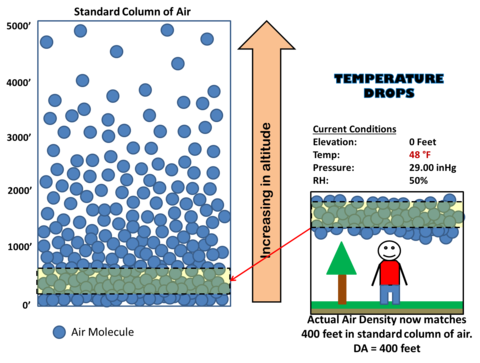
Height above sea level: Air is all around us, but we cannot see it. Gravity from the Earth pulls air down - this is called air pressure. We don't feel this pressure because our bodies push an equal amount of pressure outward. Air density and air pressure decreases with altitude (the distance above sea level). When air is near sea level, air pressure squashes it into a small space and air at high altitudes due to less air density and air pressure it spreads out. The same amount of heat is now in a bigger space, so it is more spread out. So the air is colder on top of mountains because there is less air pressure.
Distance from sea and from high mountain ranges: Places near the sea have moderate climate because water get heated and cool comparatively slower than land. When the warm air above the land rises it is replaced by the cool air from the sea. The sea breeze blow from sea to land during the day on other hand the land breeze blows from land to see at night. The land and the sea breezes helps in keeping the climate moderate in the coastal areas.
Distance from equator (latitude) : Latitude means the distance of a place from the equator. The earth gets heated by the rays of the sun falling on it near the equator. The rays falls directly and as we move away from the equator the sun rays become more and more slanting and they spread over the large land area & they also have to pass through the thick layer of atmosphere which absorbs the large part of their heat this means that the land near the equator get heated up more by the sun than the land away from the equator in a given time.

Direction of winds: a) Winds blowing from cold region make a place cool like wind blow from the mountain of the north India towards the north plain and the plain become very cold.
b) During summer the wind blow from hot desert of Rajasthan towards Delhi and Delhi becomes very hot.
c) Wind blowing from the Sea cause humidity and makes a place humid and cause rainfall like the humidity Laden wind from Indian Ocean and Bay of Bengal bring rain to India.
For example, Climate in Darjeeling is cold because it is cold in Darjeeling for most part of the Year.
The climate in northeast India is wet because it receives the rain for major part of the year.
The climate in Chennai is warm and humid.
The climate in Kerala is hot and wet.
The climate in the desert region like in Rajasthan it is hot for most part of the Year. It receives very little rainfall and it become cold in winter for short span of time. So the climate in Rajasthan is hot and dry.
Q. Why at the poles there is 6 months of day and 6 months of night?
Ans. The axis of the earth is tilted, due to which the sun continuously either shines or cannot be seen for a long time here. Although the earth rotates and day changes into night and night into day at other places, but the poles remain under the same stage for a much longer time due to the tilt.

Climate and adaptation
Adaptations to cold climates
Temperature is -37 degree Celsius
Animals- seals, polar bears are adapted to such extreme cold
1. Polar bears:
* Their body is covered with dense fur that traps the air to keep them warm.
* They have thick layer of fat under the skin provides excellent insulation.
* They have wide and large paws help it to swim.
Camouflage: Covering them to make them blend in with their surroundings.
Polar Bears with their white per camouflage in the white snow.
2. Penguin:
* They have feathers, thick skin and fat under the skin provide insulation against the cold.
* They huddle together when it's very cold to keep them warm
* Their streamlined body and web feet help them to swim
* Their white colour help them to come camouflage with snow.
3. Birds:
* They use their feathers to protect their body from cold in extreme winter.
* They migrate to the warmer region. They can also be seen in the Bharatpur and Sultanpur bird sanctuaries.
4. Seals: They have the thick deposit of fat called blubber protect them from cold.
5. Animals living in the polar region have small ears tails and legs which prevent the heat loss from the body and keep them warm.
6. In order to reduce heat loss true body activity some mammals Hibernate during winter.
Adaptation to hot climate {deserts}
*Nocturnal animals: Animals that hunt, mate, or are generally active after dark have special adaptations that make it easier to live the night life. Like snake and desert fox spend the daylight hours hiding in the Shady places like borrows or behind the boulders(a large rock) & come at night to look for the food.
* They have long legs and tails and very large ears through which they lose heat from their body and keep their body cool.
* These animals sweat, pants and lick to cool themselves. Saliva evaporates to cool their body.
Camel:
* It has a hump where fat is stored which provides it with food in times of food shortage.
* It can drink a very large quantity of water at a time and store it in its stomach.
* It's sweat little and excretes very little water in the form of urine which helps it to conserve the water.
* It features a large sole which is suitable for walking on the soft sand.
Adaptation to hot and wet climates{Tropical rainforest}:
Tropical regions are located near the equator; they have hot and wet climates which are suitable for plant growth and it also supports a large variety of animals due to the presence of warm climate, constant supply of water and availability of food.
Many animals in the rainforest are adapted to living on tree because it gives them shelter hiding places from the predators and supply them with food.
Monkey: Uses their hands and feet and also tells to swing from branch to branch.
The red eyed tree frog: Uses it sticky pad on its feet that help it to climb tree.
The long tailed macaque (beard ape):
* It is a good climber & get all the food from trees
* It mainly eat food and other parts of plant it also catches insect from under the bark of tree.
*Some animals eat food that is eaten by other animals like Toucan uses its long large bill to reach fruit on which branches.
Jaguar: It has the spotted skin through which it camouflage in the forest.
Elephant:
* It has a strong sense of smell because of its long trunk.
* It also uses trunk to pull down fruits from trees.
* It uses its trunk to tear the bark of trees to eat.
* It uses its long ear to hear soft sound and to cool itself in hot and humid climate.


Comments