


Class 8 - Chapter 1- Crop production and Management
- Gratitude miracles

- Mar 24, 2021
- 6 min read
Updated: May 11, 2021
All the living organisms need food to survive. We get energy from food which is utilised by our body for performing the different activities and body functions such as digestion Respiration and excretion.
In order to provide food for a large human population it is extremely important that a regular production management and distribution of the food is maintained efficiently.
Agriculture: ager means field and culture means to grow or cultivate.
The science and technology of food production from sowing seeds in the soil to rearing of crops and storing the plants produced is called agriculture.
CROPS: When the same kind of plants are grown in the fields on a large scale to obtain foods like cereals, pulses, vegetables and fruits etc.
* A crop of wheat means that all the plants grown in the fields are that of wheat.
For example: Cereal crops: Rice(Paddy), wheat, Maize(makka), Millet(Bajra), Barley(Jau)
Pulses crops: Gram(Chana), Peas, Beans.
Oil seeds: Mustard(Sarso), Groundnut(Moongfali), Sunflower(Surajmukhi).
Vegetables: Potatoes, Tomatoes, Onions, Cabbage etc.
Fruits: Banana, Grapes, Guava, Leeche, Mango etc.
The climatic conditions such as variation in temperature rainfall and humidity differs from one region to another therefore different crops are grown at different places based on the climatic conditions.
All the crops do not grow in the same season different crops are grown in different season based upon the climatic conditions. In India, two main kinds of Crop are grown.
Type of Crops
Crops are differentiated on the basis of season in which they grow.
There are mainly two types of crops:
Kharif crops:
The crops which are sown in the rainy season are called kharif crops.
Rainy season in India is from July to September.
The sowing(Bona) for the crops starts in June-July at the beginning of south-west monsoon because these crops require large amount of water to grow.
Kharif crops are harvested at the end of the monsoon season during September or October.
Kharif crops grow in hot and wet conditions.
For example: Rice(Paddy), Maize(makka), Millet(Bajra), Soyabean, Groundnut and cotton.
2. Rabi crops:
* The crops which are sown in the winter season are called Rabi crops.
Winter season in India is from October to March.
The sowing(Bona) for the crops starts in October- November.
Rabi crops are harvested at the end of the winter season during March or April.
Rabi crops are grown in cold and dry conditions.
For example: Wheat, Gram(Chana), Peas, Mustard and Linseed(Alasee ka beej).
3. Zaid Crops: Zaid crops are another kind of crops which are grown in some part of India during March to June. For example muskmelon, watermelon, bitter gourd, pumpkin are some zaid crops.
METHODS OF CROP PRODUCTION
The various tasks performed by a farmer to produce a good crop are called the agriculture practices. The various agriculture practices which are carried out at different stages of crop production are:
Preparation of soil: The crop plants are grown in the soil because soil provides minerals, water, air and humus to the plants and also anchors the roots of plants.
The soil is prepared for sowing the seeds of the crop by following three process:
a) Ploughing: The process of loosening and turning the soil is called ploughing or tilling.
Importance of ploughing soil:
i) The loose soil has a lots of air trapped in it which is used by the root to breathe easily.
ii) The loose soil allow the root to penetrate deeper into the soil so that plants are held more firmly to the ground.
iii) The loose soil helps in the growth of earthworms and microbes in the soil. They provide nutrients to the soil humus to the soil and also help in for the turning and loosening the soil.
iv) The loosening and turning of soil brings the nutrient rich soil to the top so that plants can use these nutrients and grow well.
v) Loose soil mix is more uniformly with fertilizers.
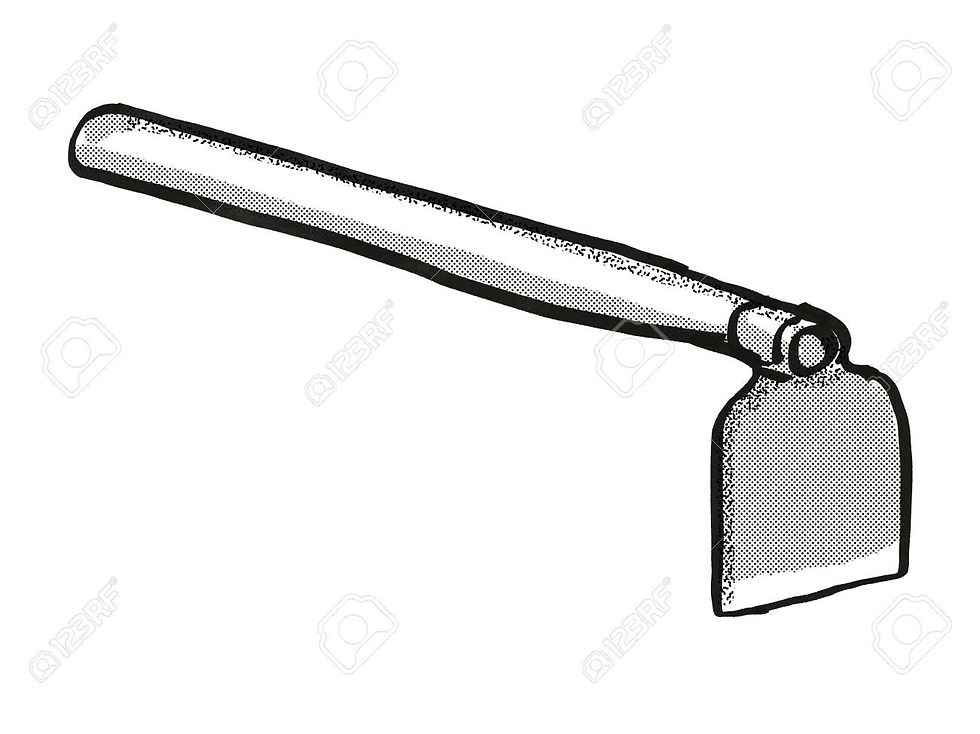
The main agriculture tools used for losing and turning the soil are:
Plough, Hoe and Cultivator.
Plough

Hoe
Cultivator

After ploughing, if the soil is very dry, it breaks into large crumbs(tukada). The crumbs broken down by using a soil plank called crumb crusher.

b. Levelling: The ploughed soil is quite loose so it is liable to be carried away by strong winds or washed away by rain water.
Soil erosion: The removal of top soil by wind and water is called soil erosion.
So it necessary to level the ploughed soil to prevent soil erosion. The ploughed soil is levelled by pressing it with wooden or iron leveller.
Importance of levelling the soil:
1. Prevents soil erosion.
2. Levelling helps in uniform distribution of water in the field during irrigation.
3. Levelling helps in preventing the loss of moisture from ploughed soil.
2. Seed selection and sowing: The process of putting seeds in the ground soil for growing the crop plants is called sowing.
Before sowing, good and healthy seeds need to be selected because they are clean, healthy seeds free from infection and diseases.
Process of selecting healthy seeds:
Put all the seeds in bucket containing water and mix well and leave it for sometime.
Healthy seeds settles down at the bottom because they are heavy and spoiled seeds are hollow and light and hence floats on the water. Then, by decantation process healthy seeds can be separated and dry it well.

Methods of sowing seeds:
Seeds are sown in the soil by two different methods:
a. Broadcasting(Manual Method): The sowing of seeds by hands is called broadcasting. In this process seeds are taken in hand and randomly scattered in entire ploughed field. It is not efficient as it can neither ensure proper spacing between the seeds not the correct depth.

b. Using seed drill: It is a mechanical method which is better than broadcasting.

Benefits of using seed drill over broadcasting method:
a. Through seed drill, seeds are sown at proper distance and appropriate depth.
b. They are sown faster, saving time and labor.
c. Since seeds are not scattered on the soil, it prevents them from getting picked up and eaten by birds.
d. It ensures that the seeds are not over crowded at one place and nutrients are available to them uniformly.
c.Transplantation: Some crops such as rice, tomatoes, brinjal and chillies are not directly sown in the fields. These are first sown in the nurseries. When the seedlings grow, they are manually transferred to the fields and this method is known as transplantation.
This enables the farmer to select healthy saplings and plant them at proper distance.


3. Adding manures and fertilizers:
Practices used by farmers to improve the nutrient value of the soil:
a. Field fallow: In this method, the land is left uncultivated for one or more seasons. The microorganisms in the soil, such as bacteria, decomposes the dead and decaying organic matters and add humus to the soil. It is natural method to recover the lost nutrients to increase the soil fertility.
b. Crop rotation: Different crops need different quantities of nutrients for their proper growth. When a single crop is grown on a piece of land year after year, the nutrient in the soil get used up and reduce the yield of the crop.
The practice of growing different crops alternatively on the same piece of land is called crop rotation.
c. Why farmers add manures and fertilizers to the soil?
Ans: Plants need nutrients from soil for healthy growth. When crops are grown in the same field again and again, the nutrients in the soil get used up and reduce the yield. In order to increase the nutrient level of the soil, farmers add manures and fertilizers.
Distinguish between Manures and Fertilizers:
Manure
1. A manure is a natural substance. It is obtained by the decomposition of animal and
buffaloes and plant residues.
2. A manure contains small amounts of essential plant nutrients such as nitrogen, phosphorus and potassium.
3. A manure adds a great amount of organic matter in the form of humus in the soil.
4. Nutrients present in the manure are absorbed slowly by the crop plants since manure is not soluble in water.
5. A manure is not nutrient specific and it tends to remove the general deficiency of the soil.
6. A manure is voluminous and bulky so it is inconvenient to store, transport, handle and apply to the crop.
7. A manure is cheap and is prepared in rural homes or fields.
8. Compost(mostly prepared from plant waste, also includes animal dung are decomposed by using microbes such as bacteria), Vermicompost( prepared from both animals and plants waste, where earthworms are used for decomposing the material quickly), Green manure(crops such as legumes are cultivated in the land and then ploughed back in the soil).
Fertilizer
1. A fertilizer is a human made substance. It is an inorganic salt.
2. Fertilizers are very rich in plant nutrients such as nitrogen, phosphorus and potassium.
3. A fertilizer does not add any humus to the soil.
4. Being soluble in water, a fertilizer is readily absorbed by the crop plants.
5. A fertilizer is nutrient specific. It can provide specifically nitrogen, phosphorus and potassium to the soil according to the need.
6. A fertilizer is compact and concentrated so it is easy to store, transport and aooly to the crop.
7. A fertilizer is costly and is prepared in factories.
8. NPK fertilizer (rich in nitrogen, phosphorus and potassium) and urea are commonly used fertilizers.
4. Irrigation:
The process of watering crops at regular intervals is called irrigation.


Comments