


CLASS - 7 - Transportation of materials in plants and animals.
- Gratitude miracles

- Feb 7, 2021
- 12 min read
Updated: May 11, 2021
CHAPTER 12 - TRANSPORTATION OF MATERIALS IN PLANTS AND ANIMALS.
Transport means ‘to carry things from one place to another’.
* The body of an organism requires nutrients and oxygen to carry out various life processes. * Waste products, produced due to the various functions inside the body also need to be transported and removed.
Therefore, the term transport may be defined as a life process in which a material is absorbed in one part or organ of an organism and is carried to other parts in its body.
Transportation of materials in Plants
* Plants take up water and dissolved minerals from the soil through their roots and transport it to their leaves.
* The leaves use this water and mineral for synthesising their food by the process called photosynthesis.The food produced by green plants in transported back to all the parts of plant body.
Therefore, it is clear that plants also need a transport system for carrying water, minerals and food through various parts of their body.
Most plants have a well- developed transport system called a Vascular System.
Vascular System is composed(formed) of specialised vascular tissues.
Vascular tissues are of two types:
* Xylem: It transports water and minerals upwards from the roots.
*Phloem: It tranorts food(glucose) from leaves to other parts of the plants.
Transport of Water and Minerals Plant root absorbs the water and mineral from the soil. The roots possess root hair which increase the surface area of the root for absorption of water and minerals nutrient that is dissolved in the water.
Water and dissolved minerals are absorbed by the roots from the soil by the process called osmosis.


Water enters the potato by osmosis.
Osmosis is the process of the fusion of water molecules across a semipermeable membrane from higher concentration to lower concentration.
A semipermeable Is a membrane that allows only some kind of molecules to pass through it by diffusion.
Diffusion is the movement of a substance from an area of high concentration to an area of low concentration. Diffusion happens in liquids and gases because their particles move randomly from place to place. Diffusion is an important process for living things; it is how substances move in and out of cells.
Water is absorbed by the roots from the soil by the osmosis process. The root hairs are in close contact with water in the soil. The concentration of water molecules is greater outside the root hair then inside. So water moves into the root hair and it then passes through the root tissues to the xylem in the roots.
Absorption and flow of water is a continuous process through the xylem tissue. Xylem tissues are the continuous network of channels which connect roots to the leaves through the stem and branches. It thus transports water and minerals to the leaves of the entire plant.

Transpiration The process of evaporation of water through the stomata present on the surface of leaves is called transpiration. The continuous evaporation of water from the leaves produces an upward pull, called a suction force. This force pulls the water from roots upward through the stem, branches and finally to the leaves. Though transpiration causes loss of water from the plants, still it is a necessary process for plants due to the following reasons:
Suction pull caused due to the evaporation of water helps to draw water to a great height in tall trees.
It produces a cooling effect on the plant and therefore, prevents the plants from the damage caused by heat of sunlight.
It also helps in the transport of water and minerals to the leaves for performing photosynthesis in them.
The rate of transpiration increases in a hot sunny day or in moving air. This happens because the heat from sun or moving air causes evaporation of water at a faster rate from the stomata. Increases in the rate of transpiration cause an increased rate of absorption of water through the roots. Therefore, when a potted plant is kept under the moving fan, the absorption of water through root will be increased along with the increased rate of evaporation.

The transportation of water and dissolved mineral salts, from root to the stem,leaves and different parts of plants takes place through xylem. This upward movement of sap( the liquid in a plant or tree) that contains water and minerals is called ascent of sap.
If water is lost through transpiration more quickly than it is absorbed by the root hairs, the plant cells will loose water. The leaves, stems and flowers will droop. This is called Wilting.
Transport of Food Material The food manufactured in the leaf is transported to different parts of plants. This transportation of food material from leaves to the other parts of plants is carried out by the tissue called phloem and the process of transport of food material is called translocation.
Translocation takes place through phloem tissue. While water can move through xylem only in upward directions,food can move through phloem in upward as well as in the downward direction.

CHAPTER 12 - TRANSPORTATION OF MATERIALS IN PLANTS AND ANIMALS.
TRANSPORTATION OF MATERIALS IN ANIMALS
Transport means ‘to carry things from one place to another’.
The body of an organism requires nutrients and oxygen to carry out various life processes. Waste products, produced due to the various functions inside the body also need to be transported and removed.
Therefore, the term transport may be defined as a life process in which a material is absorbed in one part or organ of an organism and is carried to other parts in its body. In animal body, these functions are carried out by an internal transport system called as circulatory system.
Circulatory System
Blood circulatory system is the main transport system in human beings and animals. It makes food, water and oxygen available to every parts of the body and helps in removing waste material (urea, CO2, etc).
The circulatory system consists of blood, blood vessels and heart.
Blood It is a fluid tissue that flows in blood vessels. It is red in colour and it flows through a network of tubes in whole body called blood vessels. Blood is pumped to every part of the animal by heart.
Blood consist of four components, i.e. plasma, Red Blood Cells (RBCs), White Blood Cells (WBCs) and platelets. Plasma is a liquid while RBCs, WBCs and platelets that float in it.
1. Plasma It is the sticky liquid part of the blood which is pale yellow in colour. It is 90% water and 3.5% common salt. It contains dissolved substance such as digested food and waste products and carry them from one part to another part in the body.

2. Red Blood Cells (RBCs) RBCs are red in colour due to the presence of pigment called haemoglobin. This pigment carries oxygen by binding with it.
Haemoglobin is a red protein that binds with oxygen and transports oxygen to all the parts of the body and ultimately to all the cells.
It is the presence of haemoglobin which makes the blood appear red.
When haemoglobin binds with oxygen, it forms oxyhaemoglobin which is transported to various body parts.
The carbon dioxide from the various body parts is transported back by binding again with haemoglobin. It forms carboxyhemoglobin with C02, this C02 is expelled out from the body.
3. White Blood Cells (WBCs) The WBCs fight against infection and protect us from diseases. WBCs kills the germs (like bacteria) that cause disease. WBC also makes antibodies that fight against infection. The number of WBC is quite less than RBC. WBC can change their shape and move on their own. They can squeeze out of the blood vessels to reach any part of the body.
4. Platelets Blood platelets are formed in the bone marrow. These are colourless and help in the clotting of blood in a cut or wound. If a cut or wound is made the blood starts flowing from it, after some time the platelets plug the cut and the bleeding stops due to the formation of a dark red clot.
If the platelets are not present in the blood, the blood flow from the cut or wound will not stop causing excess loss of blood which may be fatal to a person leading to death.
Functions of Blood Various functions of blood are
It transports substances like digested food from the small intestine to the other parts of the body.
It carries water to all the parts of the body.
It carries oxygen and C02 during circulation.
It carries waste products like urea from liver to kidney for excretion in urine.
It protects the body from disease(WBC).
Blood Vessels These are tubes or pipes that carry blood throughout the body. It runs between the heart and the rest of the body. There are three major types of blood vessels in the body, i.e. arteries, veins and capillaries.
1. Arteries * These carry blood from the heart to all the parts of the body.
* Arteries have thick elastic walls as the blood flows at high pressure due to pumping action from the heart through arteries. No valves are present in the arteries.
* The arteries normally carry oxygenated blood from the heart but one artery called pulmonary artery carries deoxygenated blood from the heart to lungs.

2. Veins * These are the blood vessels that carry blood from all the parts of the body back to the heart.
* These tube-like blood vessels are situated just under the skin and can easily be seen as greenish-blue tubes or lines below the skin.
* Veins have thin walls and blood flows at low pressure through the veins.
* Veins have valves in them which allow the blood to flow in one direction and prevent the backflow of blood in veins. Usually, veins carry deoxygenated blood but pulmonary vein that is connected to the left atrium of the heart carries oxygenated blood from the lungs to the heart.

Pulse Rate
The stretching and relaxing of the arteries with each heartbeat is felt as a throbbing called pulse. To know your pulse rate, place the middle and index finger of your right hand on the inner side of your left wrist. You will feel the throbbing movement at this place. This throbbing is called the pulse the pulse is produced due to the blood flowing in the arteries.
The number of beats per minute is called the pulse rate.

At the resting phase, a normal person has a pulse rate between 72-80 beats per minutes. Run for about 5 minutes and again measure the pulse rate, you will notice that the pulse rate per minute will be increased after running.
3. Capillaries These are extremely thin blood vessels that connect the arteries to veins. These allow substances to pass from blood into the body cells and also from body cells into the blood. The exchange of substances like food, 02, C02, etc., between the blood and the body cells take place through the capillaries.
Oxygenated and Deoxygenated Blood The blood that carry oxygen in it is called oxygenated blood, i.e. it is rich in oxygen. The oxygenated blood comes from the lungs, where oxygen from the fresh air gets mixed into blood and is carried towards the heart.
The blood that is rich is carbon dioxide, i.e. all oxygen has been used by tissues and organs is called deoxygenated blood. It is formed in alt the organs of the body except lungs. Oxygenated blood is bright red in colour while deoxygenated blood is darker in colour.
Heart
The heart is an organ which beats continuously as a pump for the transport of blood carrying other substances with it, through a network of tubes or blood vessels. The heart pumps blood throughout our life without stopping or relaxing.
Location of Heart The heart is located in the chest cavity slightly towards the left side. It lies between the two lungs and above the diaphragm. The heart is made up of special muscles called cardiac muscles that do not fatigue and are not the solid muscle. The size of our heart is roughly equal to our left fist.
Structure of Heart The heart has four compartments called as chambers. The upper two chambers of heart are called auricle(receives the blood)and the lower two chambers of heart are called ventricles(transports the blood).
On the left side of heart are left auricle and left ventricle and on the right side of the heart are right auricle` and right ventricle.
The auricle and ventricles are separated by valves. These are the muscular flaps that allow the blood to flow in only one direction. The right side of the heart carries deoxygenated blood while the left side of the heart carries oxygenated blood. The heart is separated by a partition called septum (from right side of the heart to the left side). This prevents mixing of oxygenated and deoxygenated blood inside the heart.
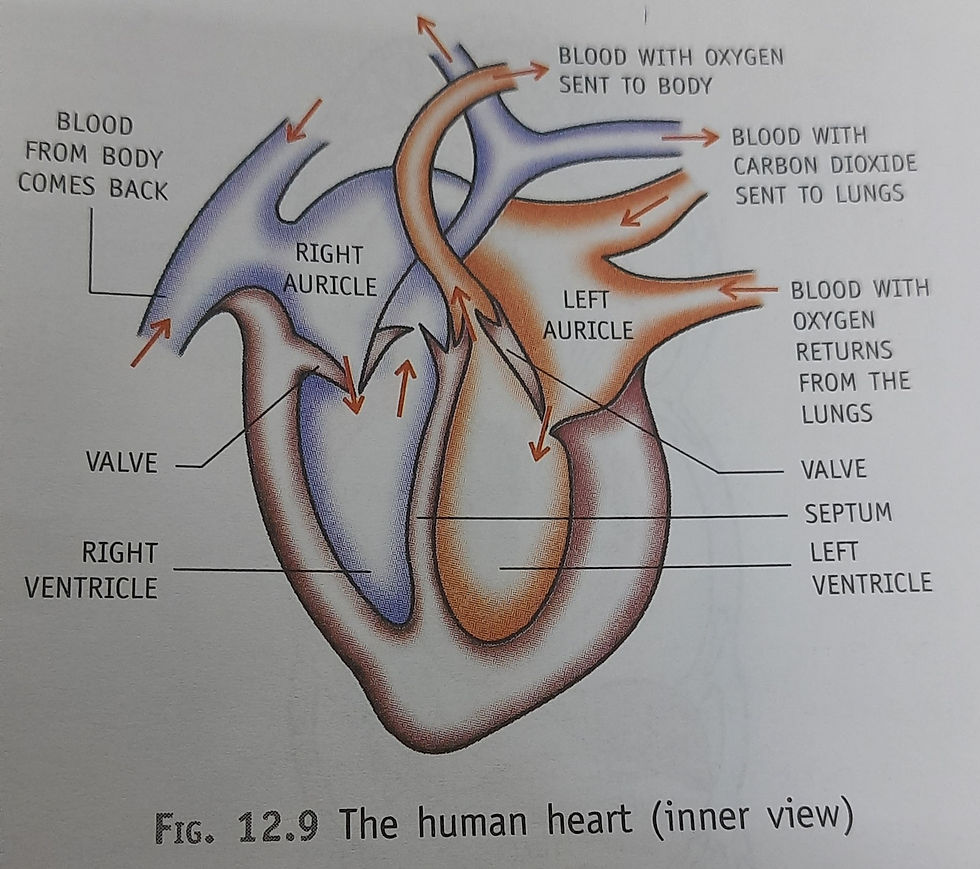
Left and Right Side of the Heart The left and right side of the heart act as two separate pumps. The left side of heart pumps the oxygenated blood into the whole body, while the right side of heart pumps the deoxygenated blood to the lungs. The oxygenated blood must be kept separated from deoxygenated blood to supply good amount of oxygen to the body cells for respiration and release of energy.
If the oxygenated and deoxygenated blood will mix with each other, the body cells will not be able to get enough oxygen for respiration due to which less energy will be released in the body.
Heartbeat The rhythmic contraction and relaxation of heart muscles that produce a specific sound of lubb-dubb is called heartbeat. The average heartbeat of an adult person is 72-80 beats per minute at resting but the number increases during and after a physical exercise or when a person is excited. During fast beating of heart, the blood is pumped more rapidly to the organs to supply more oxygen to the body cells. It helps in rapid respiration and to produce more energy. The heartbeat is equal to the number of pulse in a minute.
Mechanism of Circulation The contraction of two auricle is immediately followed by the contraction of two ventricles which leads to the continuous flow of blood in the human body. The mechanism of circulation can be summarised as follows:


Excretion The process of removal of waste materials produced in the cells of the living organism is called excretion. When our body uses food, water and air, it produces some by-products or unwanted substances. These are called waste materials. These waste material are toxic or poisonous and causes harm to the body. These poisonous substances if get mixed with blood may become fatal and may cause the death of an organism. Therefore, the waste material must be removed from the body so that a person may stay healthy.
These waste material produced after the various functions of body cells include CO2, urea, sweat, etc. These waste materials are removed from the body different organs of the body like lungs (CO2), kidney (urea) and sweat glands (sweat). These parts or organs of the body that are involved in the process of excretion are called excretory system.
Excretory System in Humans Urea is the major waste product released in our body. It is produced as a waste product of the decomposition of unused food proteins in the liver. It is a poisonous substance which must be removed from the body. Urea from blood is removed by the kidney. Therefore, the kidney is the main excretory organ in our body. The urea and other unwanted salts when dissolving in water form a yellowish liquid waste called urine. It consists of 2.5% urea, 2.5% other waste salts and 95% water. An adult human being normally passes out 1-1.8 L of urine per day. The excretory system collects the urine and remove it. The excretory system of human being consists of two kidneys, two ureters, a bladder and a urethra.
Kidneys These are called the magic filters. Kidney are bean-shaped organs present at the back of our body, just above the waist. It is brick red coloured about 4 inches long. It is richly supplied with blood vessels. Kidney can filter the unwanted substances from the blood. Each kidney consists of thousands of tiny filters called nephrons. When the blood containing urea and other waste salts pass through these nephrons, it filters the blood and removes urea and salts and urine are left in the kidney.
The urine thus formed by each of the kidney is then passed through the ureter (a tube-like structure which connects the kidney to the bladder) to urinary bladder. The urine is stored in the urinary bladder for some times and at regular intervals it, is removed through the opening at the end of the tube called urethra. The process of ejection of urine is called micturition.
The opening of urinary bladder is controlled by the ring of muscle called as bladder sphincter. When the bladder becomes full with urine this bladder sphincter opens and allows the urine to flow out.
Carbon Dioxide It is produced as a waste product in our body cells during the process of respiration. The food is broken down during respiration to release energy and releases CO2 as a by-product. This CO2 is removed from our body by the lungs during exhalation. Therefore, lungs also act as the excretory organs for removing the waste product, CO2from the body.
Sweat It is the liquid waste of the body that is produced by the sweat glands present in our skin. Sweat contains water, some unwanted salts and urea in a very small amount. During hot summer, we sweat a lot. This gets evaporated from our body. This helps to provide the cooling effect to the body. The two major functions of sweat are as follows :
It helps to remove excess water, salt and urea from the body.
It helps to keep our body cool during hot summer days.
Dialysis The normal functioning of the kidney is necessary for good health of a person. But sometime s the kidney may stop working due to infection or injury. This condition of kidney is called kidney failure which may lead to the accumulation of urea in the blood of a person. Since, urea is a toxic substance which must be removed from the blood. Such person having kidney failure cannot survive unless his blood is filtered periodically through the artificial kidney machine to remove urea. The process used for cleaning the blood of a person by separating the waste product urea from it is called dialysis.This machine removes urea and other waste the product periodically.
The long term solution for the patient suffering from kidney failure is kidney transplantation. In this method, the diseased or damaged kidney is removed and the matching kidney is donated by a healthy person. The donated kidney is transplanted in its place by performing ^surgery.
Excretion in Animals Like humans, animals also excrete waste products from their body. The way in which waste materials are removed from the body of the animal depends upon the availability of water. Fishes are the aquatic animals that excrete ammonia as their waste product. This ammonia is excreted in the gaseous form which directly gets dissolved in water. The land animals like lizards, birds, snakes, etc, have less water availability. These animals excrete this waste material in the form of uric acid pellets. These are white coloured semi-solid excretory products of several land animals. Urea is the excretory product of animals like human, cow, goat, etc. and is eliminated as urine.
Amoeba, Paramecium, etc., are the unicellular organisms and their excretory products are removed by diffusion from the body of the organism into the surrounding water.


Comments