


CLASS 7 LIGHT
- Gratitude miracles

- Dec 27, 2020
- 17 min read
Updated: May 11, 2021
TOPICS COVERED
* Light
*Rectilinear propagation of light
*Reflection of light
*Image - Real and Virtual
*Properties of image formed by plane mirror.
*Spherical mirror - Concave and Convex mirror
*Image formed by Concave and Convex lens
Q What is light?
Ans. Light is a form of energy, which causes the sensation of vision.
Q How light help to see any object around you?
Ans. First the light falls on an object and when it is reflected from an object it enter into our eyes and the object become visible to us

Rectilinear propagation of light
The Rectilinear Propagation of Light describes that Light travels in a Straight Line.
Activity 2
We take three pieces of cardboard. Place them one on the top of one another and make a hole in the middle of each cardboard by using a thick nail. Erect these cards up on the table at a short distance away from each other. Take a candle which is of the same height as the holes in the cards. Light the candle and place it in front of the cards. We see that the light of the candle is visible only when the holes on cards lie in a straight line.
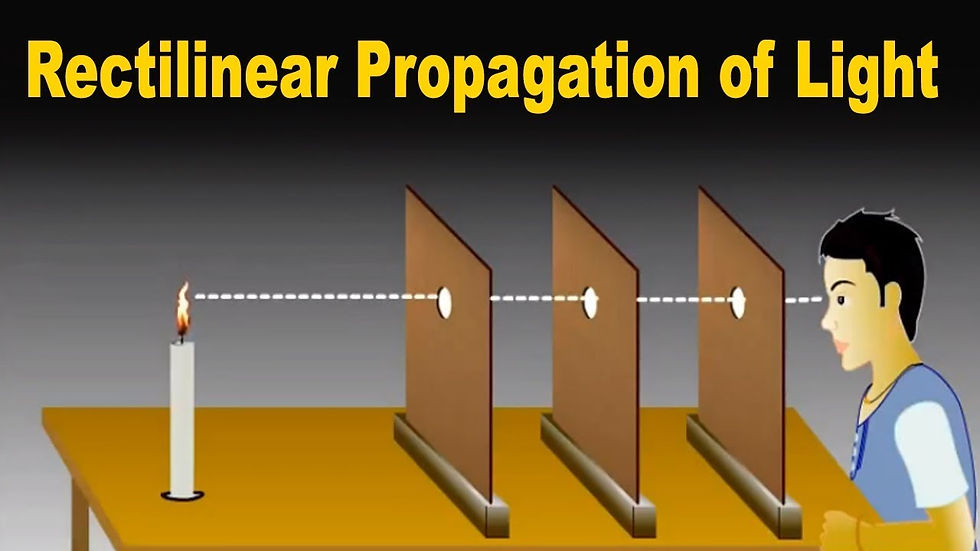
If we disturb them the light of the candle disappears. This experiment shows that light propagates in a straight line.
Reflection of light
Reflection is the change in direction
When the light fall on an object a part of it bounce back into our eyes and we can see the object. The bouncing of the light from a surface is known as a reflection of light.

* The light ray which falls on the surface of a mirror IO from source of light is called incident ray
* The light ray which get reflected back from the surface of the mirror OR is called reflected ray
* A point at which incident ray strikes on the mirror is called point of incidence.
* A line perpendicular to the mirror drawn from the point of incidence is called Normal ON
* Angle between the incident ray IO and normal ON is called angle of incidence (<i)
* Angle between the reflected ray OR and the normal ON is called the angle of reflection(<r)
When light ray reflected back from a surface it follows two laws called laws of reflection.
Law of Reflection
* Angle of incidence (<i) is equal to the angel of reflection (<r).[<i = <r]
* Incident ray, reflected ray and normal all lie in the same plane.
REAL AND VIRTUAL IMAGES
Real Image: The image which forms on screen is called real image.
Example: Image formed by projector in cinema hall is a real image.
Image formed by concave mirror is a real image.
As light from an object enters our eyes, its real image is formed on the retina(screen of the eye).
The real image is obtained by using a converging(CONVEX LENS) lens or a concave mirror. The size of the image depends upon the placement of the object. The real image is always inverted(upside down).

Virtual Image: The image which forms behind the screen is called virtual image.
Example: Image formed by the plane mirror is a virtual image.
Image formed by convex mirror and concave lens is a VIRTUAL image.
The virtual image, on the other hand, is an upright image that can be achieved where the rays seem to diverge but do not converge in reality. This image can be produced with the help of a diverging lens or a convex mirror.

NATURE OF IMAGE FORMED BY A PLANE MIRROR
Virtual(behind the screen).
Erect(upright)

3. Image is as the same size of the object.
4. Appears to be as much behind the mirror as the object is in front of it.
5. Laterally Inverted.

Image Formed by Spherical Mirror Spherical mirrors form images of the objects placed in front of them. So, these images are formed, when light rays coming from the object fall on the mirror, get reflected and converge(Meets) or diverge(separates). We can use a spoon in order to understand the image formation by a spherical mirror.
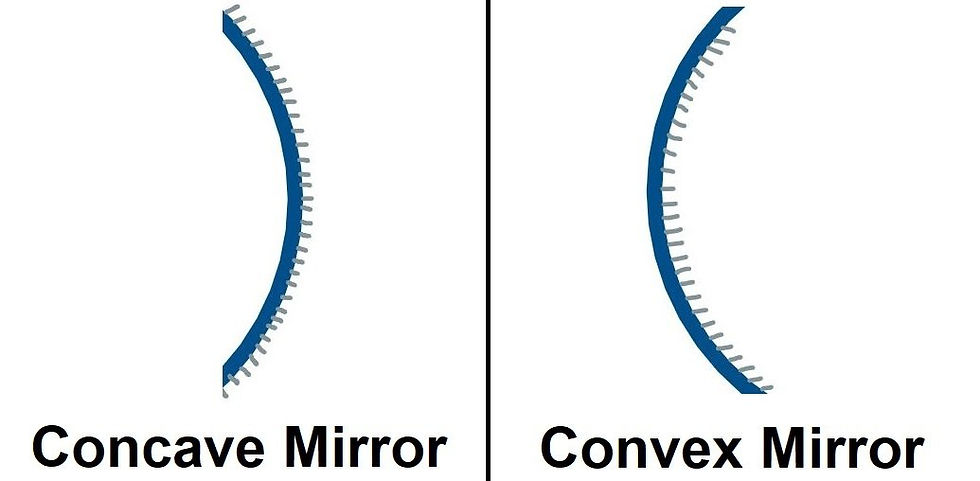
The spherical mirrors are of two types:
Concave mirror
Convex mirror
e.g. A shining steel spoon represents both a convex mirror as well as a concave mirror.

The front side (or inner side) of a spoon is bent inward, represents a concave mirror.
The back side (or outer side) of a spoon is bulging outward, represents a convex mirror as shown in figure.

Concave Mirror (Converging Mirror)
The mirror whose reflecting surface is concave (and polished surface is convex) is called a concave mirror.
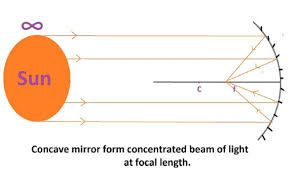
The concave mirror reflects the parallel rays of light in such a way that after reflection, all the rays converge (or meet) at one point called focus in front of the mirror. Since a concave mirror converges a beam of parallel light rays. Therefore, a concave mirror is also known as a converging mirror.

Pole: The centre of a mirror(reflecting surface). It is represented by letter P.
Centre of Curvature: The centre of the sphere of which the mirror forms the part. Represented by "C".

Radius of Curvature: The radius of the sphere of which the mirror forms the part. Represented by "R".
Principal axis: The straight line joining the pole (P) and the centre of curvature. It is normal to the mirror at its pole. Focus: The point of the principal axis at which the rays parallel to principal axis meet (concave mirror) or appear to meet (convex mirror) after reflection. Represented by F. Focal Length: The distance between the pole and the principal focus of a spherical mirror is called focal length. Represented by f.

Q. Why a concave mirror burns a paper using sunlight? Can it be done by a convex mirror? Why or Why not? Explain.
Ans. The concave mirror burns a paper because it has ability to converse / focus all the sunrays at a point .So it burns the paper .A convex mirror cannot burn a paper since it is a diverging mirror light rays cannot be focused at a point.
Click on the link above to see the live experiment of burning paper through concave mirror or convex lens.
Image Formed by a Concave Mirror When the Object is Far Off A concave mirror forms a real image of the sun. We can understand the formation of the image by a concave mirror when the object is far off by an activity.
Therefore, we can conclude that the image formed by a concave mirror is much smaller than the object (highly diminished) and real because it can be obtained on a sheet of paper (which is a kind of screen). So, when an object is placed at a far off distance front a concave mirror, then image formed by a concave mirror is
real
inverted
much smaller than the object.

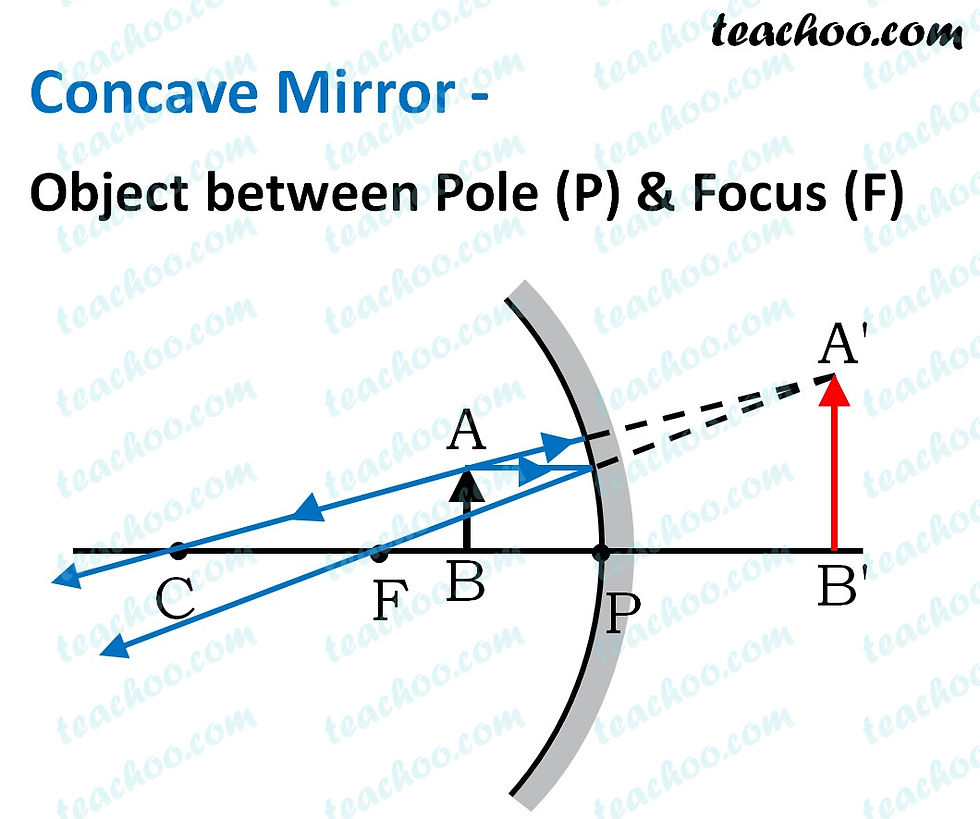
Image Formed by a Concave Mirror When the Object is Placed Close to Concave Mirror Let us perform an activity to understand the formation of image by a concave mirror when the object is placed close to the concave mirror.
Since the image can be observed only by looking into the concave mirror and cannot be formed on the screen, therefore, the image is virtual. If we look at the image in the concave mirror, we find it to be the same side up as the candle, so the image is erect. And if we compare the size of the candle and its image, then we will find that the image is larger than the candle. Therefore, the image is larger than the object (enlarged or magnified).
Hence, we can conclude that when an object is placed close to a concave mirror, the image formed by the concave mirror is
virtual
erect
larger than the object (enlarged or magnified).
Uses of Concave Mirrors
To see the large image of teeth of a patient, concave mirrors are used by the dentist.
In torches, headlights of vehicles and searchlights to get a strong, straight beam of light, etc., concave mirrors are used as reflectors.
To see a large image of the face, then concave mirrors are used as shaving mirrors.
Convex Mirror (Diverging Mirror)
The mirror whose reflecting surface is bulging or convex (polished surface is concave) is called the convex mirror. After reflection from the convex mirror, the parallel rays of light are spreading out. When the parallel rays of light spread out, we can say that the rays of light are diverging.
Now, we can say that a beam of parallel light rays diverges (spreads out) after reflection from a convex mirror. Since a convex mirror diverges a beam of parallel light rays, therefore, it is also known as a diverging mirror.
Image Formed By a Convex Mirror Let us perform an activity to understand the formation of an image by a convex mirror.


The image of the candle can be seen only by looking into the convex mirror and cannot be formed on a screen. It is a virtual image. If we look at the image in the convex mirror, we will find that it is the same side up as the candle. So, the image is erect. And if we compare the size of the candle and its image, the image appears to be smaller. Therefore, the image is smaller in size than the object (or diminished). Even if we change the distance of candle (object) from the convex mirror, we will notice that in every case, the image of the candle formed by the convex mirror remains virtual, erect and smaller in size than the candle. So, we can conclude that whatever be the distance of the object from a convex mirror, the image formed by a convex mirror is always
virtual
erect and
smaller than the object (or diminished).
Uses of Convex Mirrors
To see the traffic at the rear side or backside on the road, convex mirrors are used as rear view mirrors or side view mirrors in vehicles such as cars, scooters, buses, etc.
Big convex mirrors are used as shop security mirrors. By installing a convex mirror in the shop, the shop owner can keep an eye on the customers.

Image Formed by Lenses Since a lens is a piece of transparent glass bound by the two spherical surfaces. Lenses are transparent so that light can pass through lenses. Lenses are of two types:
Convex lens
Concave lens

Get some lens and try to touch them, we will find that some are thicker in the middle than at the edges and some are thinner in the middle than at the edge.


Convex Lens (Converging Lens)
Concave Mirror - Converging
Convex Mirror - Opposite of concave means diverging.
Concave lens - Opposite of concave mirror means Diverging
Convex lens- Opposite of concave lens - Converging. The convex lens is the lens which is thicker in the middle than at the edges. A beam of parallel rays of light falls on a convex lens from the left side. After passing through the convex lens, the beam of parallel rays of light converges at a point as shown in the figure given below. Hence, a convex lens is a converging lens.

Image Formed by a Convex Lens The nature and size of the image formed by a convex lens depend on the distance of the object from the convex lens.
Why do lenses have two focus?
The reason why a lens has two foci while a mirror has only one is because of the fact that light is transmitted through a lens and not a mirror. Unlike in mirrors, images in lenses can form on either side and thus we require two foci to properly determine the formation and position of an image.


Thus, we can conclude that when an object is placed at a far off distance from a convex lens, then the image formed by the convex lens is real, inverted and much smaller than the object (or highly diminished).

Image formation by convex lens when object is placed between O and F.
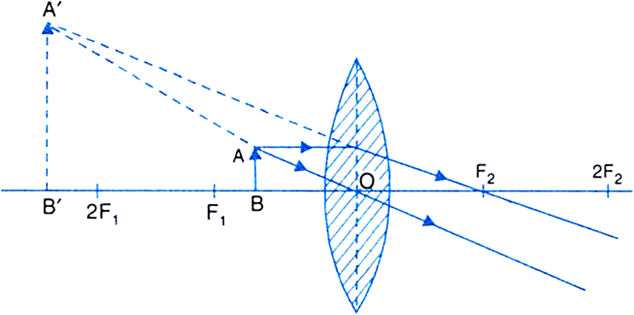
When object is placed between F and 2F

When object is placed at 2F
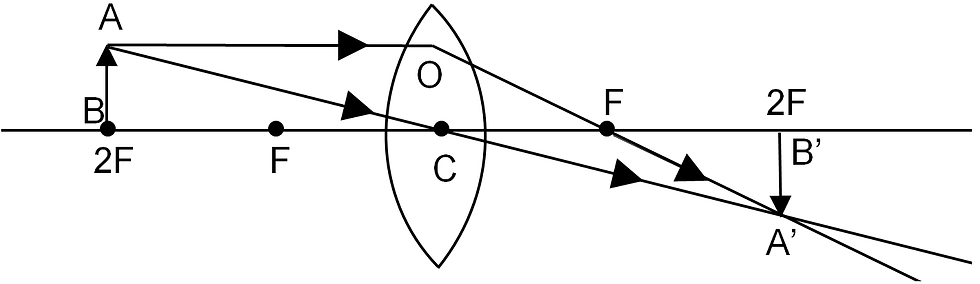
When object placed beyond 2F

Now, change the distance of the candle from the lens and try to obtain the image of the candle flame every time on the screen by moving it. So, is it possible to get in any position of the object for which image was erect and, magnified? Yes, it is possible when the candle is placed very close to the convex lens.
Uses of Convex Lenses
Convex lenses are used as a magnifying glass.
In the manufacturing of spectacles, camera, microscope, telescope and binoculars, convex lenses are used.
Concave Lens (Diverging Lens) A concave lens is a lens which is thinner in the middle than at the edge. A parallel beam of light falls on a concave lens as shown in the figure. After passing through the concave lens, the rays of light are diverging (or spreading out).
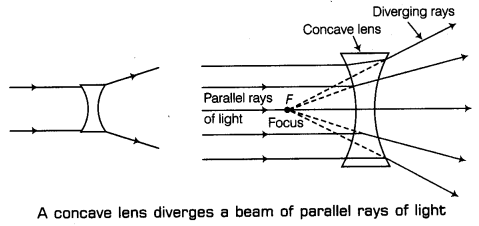
Since a concave lens diverges light rays falling on it, therefore, it is also called a diverging lens.
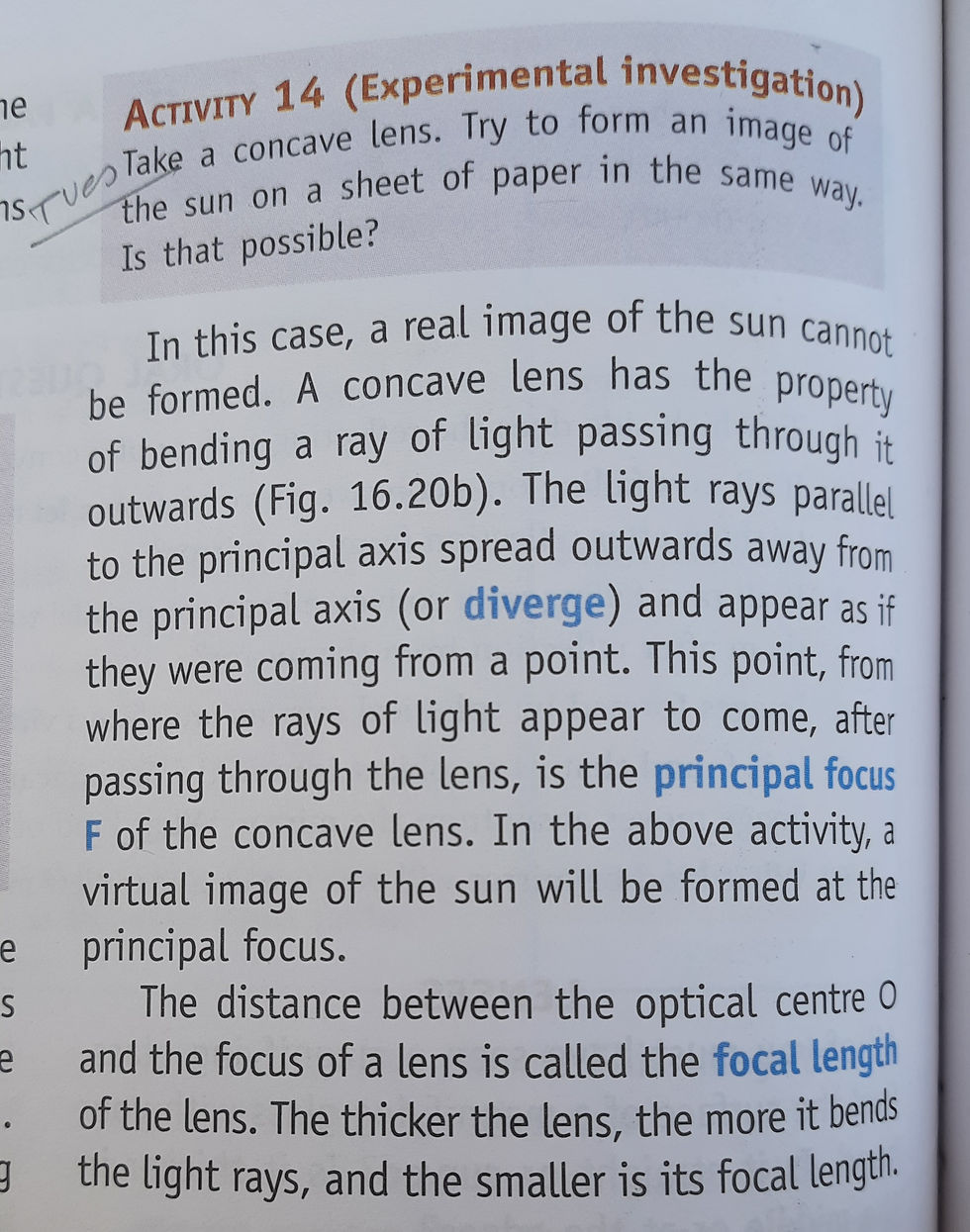
Image Formed by a Concave Lens In the case of a convex lens, we have studied that the nature of image formed depends on the distance of the object from the convex lens. But, this is not followed in the case of a concave lens.

Uses of Concave Lenses
In order to see the image of the person standing outside, concave lenses are used in the peepholes in the door of hotel rooms.
Concave lenses are used in making spectacles.
Sunlight: White or Coloured We might have noticed a rainbow which usually appears after the rain when the sun is low in the sky. An arc of seven colours seen in the sky is known as the rainbow. The seven colours of a rainbow are red, orange, yellow, green, blue, indigo and violet. We might also have seen that when we blow soap bubbles, they appear colourful. Similarly, when light is reflecting from the surface of a Compact Disc (CD), we can see many colours. The rainbow is produced by the dispersion of sunlight by tiny raindrops suspended in the atmosphere.
Dispersion of Light In the year 1665, Newton discovered by his experiments with glass prisms that white light (like sunlight) consists of a mixture of lights of seven colours. Newton found that if a beam of white light is passed through a glass prism, then the white light splits to form a band of seven colours on a white screen. The band of seven colours formed on a white screen, when a beam of white light is passed through a glass prism, is known as a spectrum of white light. The seven colours of the spectrum are Red, Orange, Yellow, Green, Blue, Indigo and Violet.

So, dispersion of light is the phenomenon of splitting up of white light into seven colours on passing through a transparent medium like a glass prism. The formation of a spectrum of seven colours indicates that white light is a mixture of seven colours. White light can be sunlight. So, now we can say that sunlight consists of seven colours. We can mix these colours to get white light. This can be done by using Newton’s disc, let us try this.
INTEXT QUESTIONS AND ANSWERS
PAGE : 187
Q1: Can light bend around objects in its path?
ANS:
No, light cannot bend around the objects, as it only travels in a straight line.
Q2: Does a plane mirror form a real image or a virtual image?
ANS:
A plane mirror always forms a virtual image of an object, because the image formed by a plane mirror cannot be obtained on the screen.
Q3: The image of which of the following letters of the alphabet will be exactly the same when seen in a plane mirror: A E I O U
ANS:
The image formed by a plane mirror is laterally inverted. Out of A E I O U, the letters I, O, and U are symmetrical about a vertical axis passing through their centers. So, even if the image of these letters will be laterally inverted, they would look exactly the same.
Q4: In a plane mirror, which is the measure of the angle of incidence—the angle between the mirror and the incident ray, or 90° minus the angle between the mirror and the incident ray?
ANS:
The angle of incidence is defined as the angle between the incident ray and the normal to the mirror. The angle of the incidence can also be obtained by obtaining the angle, 90° minus the angle between the mirror and the incident ray, which is actually equal to the angle between the incident ray and the normal to the mirror.
INTEXT QUESTIONS AND ANSWERS
PAGE: 191
Q1: To which side does the reflecting surface of a convex mirror curve–inwards or outwards?
ANS:
The reflecting surface of convex mirror curves outwards.
Q2: If all rays falling on a concave mirror are parallel to the principal axis of the mirror, what happens to them after reflection from the mirror?
ANS:
If a beam of rays, parallel to the principal axis falls on a concave mirror, the concave mirror converges all the rays at its focus.
Q3: If all rays falling on a convex mirror are parallel to the principal axis of the mirror, what happens to them after reflection from the mirror?
ANS:
If a beam of rays, parallel to the principal axis falls on a convex mirror, the mirror diverges all the rays away from its focus.
Q4: Images formed by spherical mirrors are always virtual. Do you agree? Give reasons.
ANS:
No, images formed by the spherical mirror can be real too. It depends on the position of the object in front of the lens. Example: Image of an object placed at the radius of curvature of a concave mirror is real in nature and can be obtained on the screen.
Q5: It is found that as an object is moved from a great distance to the focus of a spherical mirror, the image moves away from the mirror. What kind of mirror is it—convex or concave?
ANS:
It is a concave mirror. The image formed by a concave mirror starts shifting away from the focus when the object is brought nearby the focus.
Q6: What kind or mirror will you use as a rear view mirror in a car–convex or concave? Why?
ANS:
The mirror used as a rear view mirror in a car is a convex mirror. Because convex mirror forms a diminished image of an object, so has a wider field of view. It helps the driver to have a proper view of the backside of the vehicle.
INTEXT QUESTIONS AND ANSWERS
Page No 194:
Q1: A lens is thicker in the middle than at the edges. Can it be used to burn a piece of paper by using sunlight?
ANS:
A lens which is thicker in the middle than at the edges is a converging or convex lens. It converges all the light rays coming from a distant object to its focus. As the sun is a distant object for a convex lens, so the lens will converge all the light rays coming from the sun and will focus them on the focal point of the lens. Such a lens can be used to burn a piece of paper because sunlight focussed on a single point can produce heat and can even start a fire.
Q2:
If all rays falling on a concave lens are parallel to the principal axis of the lens, what happens to them after they pass through the lens?
ANSWER:
If a beam of light rays parallel to the principal axis falls on a concave lens, the rays diverge after reflection. When the rays are drawn backward they are seemed to meet at a point known as the focal point of the lens.
Page No 194:
Question 3:
If all rays falling on a convex lens are parallel to the principal axis of the lens, what happens to them after they pass through the lens?
ANSWER:
If a beam of light rays parallel to the principal axis falls on a convex lens, the rays converge to a point known as the focal point of the lens.
Page No 194:
Question 4:
There is only one point on a concave or convex lens, a ray passing through which is not deviated at all. Where does this point lie and what is it called?
ANSWER:
The point is known as the 'Pole' of the lens. It lies at the center of the lens. Rays do not deviate from their path if they pass through the pole.
Page No 194:
Question 5:
A lens is found to form both real and virtual images of an object, depending on the position of the object with respect to the lens. What kind of lens is it–convex or concave?
ANSWER:
A convex lens forms both virtual and real images of the object, depending upon the position of the object in front of the lens.
Page No 194:
Question 6:
Sunlight consists of light of only one colour. Do you agree? Give reasons.
ANSWER:
No, I do not agree. Sunlight appears to be a single white light but actually, it is made up of 7 constituent colours, i.e. Violet, Indigo, Blue, Green, Yellow, Orange, and Red. When the sunlight undergoes dispersion, then the seven constituent colours can be observed separately.
Page No 196:
Question 1:
The image formed by a plane mirror is (a) on the surface of the mirror (b) just in front of the morror (c) just behind the mirror (d) as much behind the mirror as the objcet is in front of the mirror
ANSWER:
(d) as much behind the mirror as the object is in front of the mirror
The object distance is equal to the image distance in the plane mirror and the nature of the image is virtual and erect; hence, the image is formed behind the mirror at a distance equal to the object distance.
Page No 196:
Question 2:
Which of the following images is real? (a) image formed by a plane mirror (b) image formed by a convex mirror (c) image formed by a concave mirror with object between the mirror and focus (d) image formed by a convace mirror with object behind the focus
ANSWER:
(d) image formed by a concave mirror with object behind the focus Real image is formed by a concave mirror with object behind the focus, that is beyond focus, is real.
Page No 196:
Question 3:
A sherical mirror with its reflecting surface on the outside is a (a) plane mirror (b) concave mirror (c) convex mirror (d) either concave or convex depending on which way you look at it.
ANSWER:
(c) convex mirror Convex mirror is a spherical mirror, which has its reflecting surface outside.
Page No 196:
Question 4:
A virtual image formed by a plane or a spherical mirror (a) is always inverted (b) is always erect (c) is erect or inverted depending on the distance of the object from the mirror
ANSWER:
(b) is always erect A virtual image formed by a spherical mirror or a plane mirror is always erect.
Page No 196:
Question 5:
If a concave mirror forms a real magnified image of an object, the object is located (a) between pole and focus (b) between focus and centre of curvature (c) beyond centre of curvature (d) at centre of curvature
ANSWER:
(b) between focus and centre of curvature Image is both magnified and real if the object is placed between the centre of curvature and the pole.
Page No 196:
Question 6:
At what position of the object does a convex lens act as a magnifying glass? (a) between F and 2F (b) between F and O (c) beyond F (d) beyond 2F
ANSWER:
(b) between F and O Magnifying glass is a single lens that produces a highly magnified, erect image of the object. In concave mirror, a highly magnified erect image is produced when the object is placed between F and O.
Page No 196:
Question 7:
Which of the following images can a convex lens NOT produce? (a) real, magnified (b) virtual, magnified (c) erect, virtual (d) erect, diminished
ANSWER:
(d) erect, diminished Convex lens cannot produce erect and diminished image.
Page No 196:
Question 8:
Band of which of these colours is not seen in a spectrum? (a) green (b) yellow (c) purple (d) red
ANSWER:
(c) purple Purple colour is not present in the spectrum.
Page No 196:
Question 9:
Which of the following is true for a convex mirror? (a) It can only form virtual images. (b) It can only form real images. (c) It can form real or virtual images depending on the distance of the object from the mirror. (d) It can form real or virtual images depending on the size of the object.
ANSWER:
(a) It can only form virtual images. A convex mirror can only produce virtual image.
Page No 196:
Question 10:
Which of the following cannot split light into its seven colours? (a) diamond cut in a special way (b) prism (c) convex lens (d) water droplets suspended in the air
ANSWER:
(c) convex lens A convex lens cannot split light into its seven colours.
Page No 196:
Question 1:
If you raise your right hand, your image in a plane mirror also raises its right hand. True of false?
ANSWER:
False. Images formed in plane mirrors are laterally inverted. Hence, if we raise our right hand, the image will appear to raise its left hand in the mirror.
Page No 196:
Question 2:
The image formed by a plane mirror can be obtained on a screen. True of false?
ANSWER:
False. The image formed by a plane mirror is virtual and erect in nature and virtual images cannot be obtained on a screen.
Page No 197:
Question 3:
The image formed by a plane mirror is as much __________ the mirror as the object is in front of it.
ANSWER:
The image formed by a plane mirror is as much behind the mirror as the object is in front of it. This is because object distance is equal to image distance in a plane mirror.
Page No 197:
Question 4:
Through which point of all rays parallel to the principal axis of a spherical mirror pass after reflection by the mirror?
ANSWER:
All rays parallel to the principal axis of a spherical mirror pass through the focus after reflection by the mirror.
Page No 197:
Question 5:
Which of these mirrors converges a parallel beam of light-plane, concave or convex?
ANSWER:
A concave mirror converges a parallel beam of light-plane.
Page No 197:
Question 6:
A real image formed by a mirror is always inverted. True of false?
ANSWER:
True. Real images formed by the mirrors are always inverted.
Page No 197:
Question 7:
What kind of spherical mirror would you use if you want to see the magnified image of your face in the mirror?
ANSWER:
We will need a concave mirror to get the magnified image of our face in the mirror.
Page No 197:
Question 8:
A convex lens _________ (converges/diverges/dos not affect) a parallel beam of light incident on it.
ANSWER:
A convex lens converges a parallel beam of light incident on it.
Page No 197:
Question 9:
Which of these has smaller focal length-a thick lens or a thin lens?
ANSWER:
Focal length of a thick lens is smaller than that of a thin lens.
Page No 197:
Question 10:
If the distance of an object from a convex lens is equal to twice the focal length of the lens, where is the image formed?
ANSWER:
Image will be formed at twice the focal length of the lens on the opposite side. If an object is placed at twice the focal length of the lens, it is said be placed at 2F position. In this case, the image will be formed at 2F position on the opposite side of the lens.
Page No 197:
Question 11:
A diverging lens forms a real image of an object placed beyond F, and a virtual image of an object placed between O and F. True of false?
ANSWER:
False. A diverging lens always forms a virtual image irrespective of the placement of the object.
Page No 197:
Question 12:
Name the triangular piece of glass that splits white light into different colours.
ANSWER:
The name of the triangular piece of glass that splits white light into different colours is prism.


Comments